
Print of the Month: Exeter, From Exwick Hill
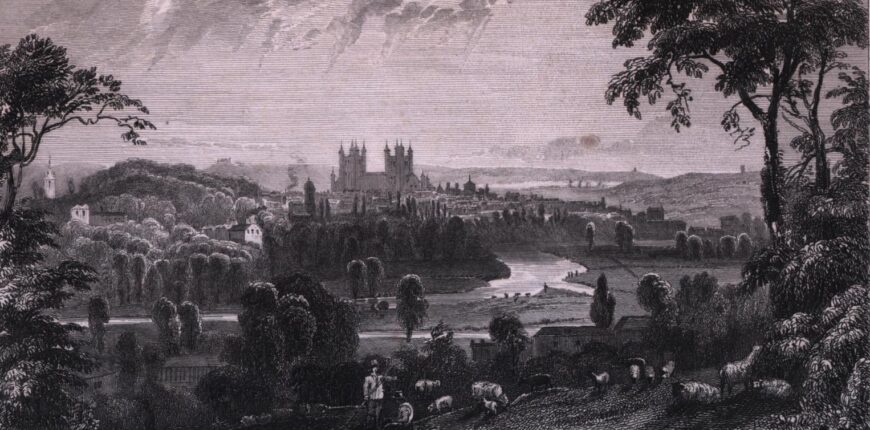
Exeter, from Exwick Hill, by Le Petit after W. H. Barlett (1829/32). Prints and Drawings Number: 04972
This blog was researched and written our Library Assistant, Isabel Moon. Isabel is currently involved in the ongoing project to digitise our prints and drawings collection.
The DEI is home to a large Prints and Drawings collection, some of which is now available to view on the South West Collections Explorer website. The image I have chosen to explore is ‘Exeter, from Exwick Hill’, by Le Petit after W. H. Barlett. This picture was originally published in various works, including John Britton’s and E. E. Brayley’s Devonshire & Cornwall Illustrated (1832), and has been described by local historian J. V. Sommers Cocks in his book Devon Topographical Prints, 1660–1870 – A Catalogue and Guide (1977), both of which can be found here at the DEI.
Prints like this are an excellent example of how the history of tourism and visual culture in the nineteenth century were inextricably linked, developing together to change how people perceived and used the countryside, and how the value of the British landscape became tied up in its value within the emerging tourism industry. The print depicts Exeter at a fascinating point in its history. It gives us a window into a moment between many different changes to the landscape itself, including the development of the railway in Devon and the changes to the cloth industry during the industrial revolution, and how new developments over this time affected the production and use of prints themselves.

John Britton and E. E. Brayley, Devonshire & Cornwall Illustrated (1832). Britton and Brayley intended to record the best views of Devon and make them accessible to more people through this book.
Somers Cocks was a well-known local Devon historian and in 1977, after years of research, he published Devon Topographical Prints. In his words, he explains that:
“Broadly speaking, [this book] sets out to answer the query as to whether any prints exist of a particular town, parish, house or view, and, so far as possible, to indicate from what, if any, book, set, or series that prints came.”
Cocks sought to remedy what he felt was a lack of guides or publications detailing the rich collection of older topographical prints for most regions of the country. For this collection, he focused on the period 1660 to 1870, beginning with the works by Wenceslaus Hollar (1607-1677), who worked in England from 1636, and ending around the 1870s, when Cocks argues the prints and drawings industry was no longer able to hold out against the growing popularity of the rival photograph.
Tourism and the Picturesque
One of the major themes regarding prints and drawings of this kind is the notion of the picturesque and how it emerged alongside growing interest in British tourism. According to Professor Patrick Young, a setting could be described as picturesque in so much as it was seen to take on the qualities of the landscape scenes created by painters and engravers from the sixteenth century onwards. During the nineteenth century, published works began to shift their focus towards depictions of natural beauty, rather than historical, mythological, or biblical scenes, as had mainly been the focus of older neoclassical and romantic paintings.
Largely as a result of people being less able to travel abroad during the Napoleonic Wars, the end of the eighteenth century saw an increased interest in domestic tourism in Britain which would continue into the nineteenth century. At this time, the ability to discern and appreciate a picturesque landscape was considered a vital part of the contemporary concept of a cultivated sensibility. Over the nineteenth century, the concept of the picturesque became increasingly adopted by the British middle classes as travel became more accessible, which had a massive impact on the visual depictions of landscapes and tourist destinations in England.
What’s interesting about the image of ‘Exeter, from Exwick Hill’ is its framing and how the artist’s perspective draws the viewer into the landscape. Christian Noack, associate professor at the University of Amsterdam, explains that new active and “embodied” tourism practices in the late eighteenth and early nineteenth century, such as walking, hiking, and mountaineering, created a new appreciation for nature and landscape. These new powerful images, he argued, invited people to recreate the perspectives themselves either in the same locations or in their adventures elsewhere. I feel this applies in many ways to this image, as the image invokes the feelings of a first-person perspective. It offers its view to any hikers or holidaymakers who wish to find this viewpoint for themselves, adding a personal and human layer to the picture.
Striking to anyone familiar with Exeter is the absence of St David’s train station. The original St David’s station was opened in 1844, around a decade after this picture was published. The development of the railways in Devon transformed industry and significantly bolstered tourism in the second half of the nineteenth century by massively increasing access to coastal towns and areas. But significant changes to Devon had also been taking place leading up to this point. Canal, river, and road transport had greatly improved, and after the 1830s, North Devon finally became more accessible via good roads. These new roads and coach routes improved access to Exeter enough to enable more people to travel to Devon and appreciate its views than ever before. This print is therefore a fascinating window into the middle of a transformative time for Exeter and England as a whole.

‘Exeter, from Exwick Hill’, by Le Petit after W. H. Barlett (1829/32). Prints and Drawings Number: 04972.
Cloth Trade and Exeter
In the foreground of the print, we see depicted two farmers herding their sheep. The cloth trade had been a cornerstone of Devon’s trade and economy since possibly as far back as 1200. However, by the nineteenth century, it was in rapid decline. Cities such as Yorkshire were turning to steam power and rapidly industrialising. They started to produce cheaper wool on a larger scale than the Devonshire markets could keep up with. Throughout the nineteenth century, wool mills began to close across Devon, causing massive damage economically and socially to the areas affected. The Napoleonic wars dealt another devastating blow to the cloth industry. For a while, the cloth trade was primarily supported by the East India Company and its trade with China. However, when this came to an end in 1833 with the end of the Company’s monopoly, Devon’s cloth industry began to decline further.
Perhaps the farmer and his sheep were included in this print out of nostalgia for the prosperous pre-industrial economy in Devon. Or perhaps it was simply what the painter saw on their visit. Either way, it is interesting to note how this image happily includes the farmers and their sheep when creating this romantic portrayal of Exeter and its surrounding landscape.
Prints and Technology
Another period of change that this image is situated in is the changes to technology regarding the production of prints themselves. Copper line engraving had been the dominant type of print during the seventeenth and eighteenth centuries. Exeter, from Exwick Hill however, was printed using the at the time relatively new steel line engraving method. This new technique was first used by topographical artists in Devon in the 1820s and was the method used for the popular small vignette images of the 1840s and onwards. The harder metal allowed for longer runs using the same sheets before they wore down. It also allowed for finer lines to be drawn and therefore more detail and overall better quality prints to be produced and as a result it overtook the older copper line engraving method in popularity.
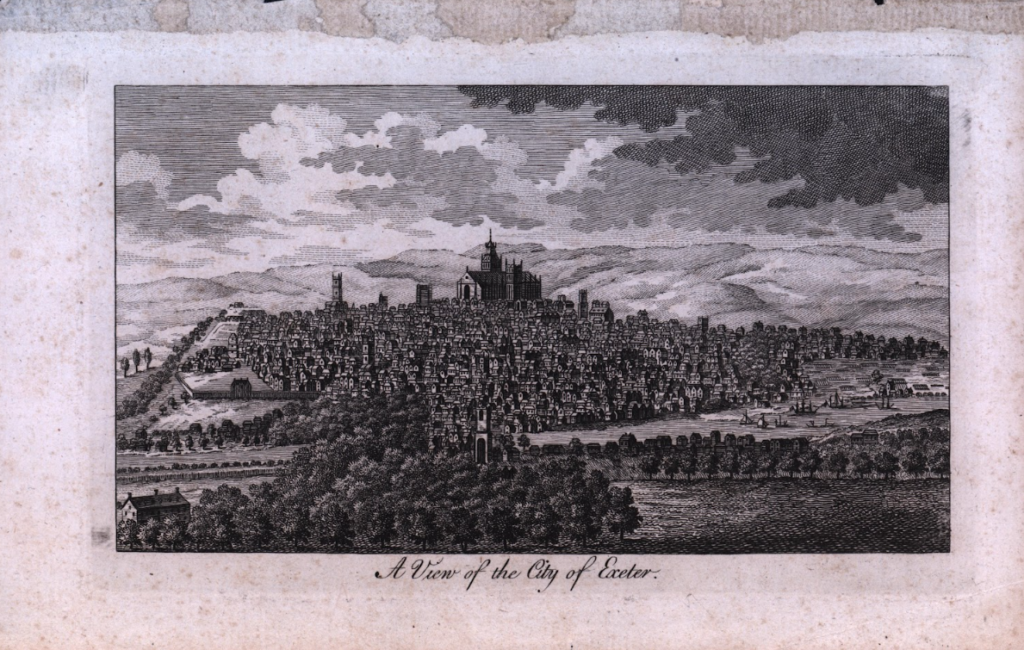
‘A View of the City of Exeter’, by and unknown artist, c1775. Prints and drawings number: 04970. This older print was made using the copper line engraving method.
Prints and Visual Culture
Somers Cocks was able to tell a lot about the history of printmaking from his discoveries and his collection. For example, he identifies in his book that the creation of prints followed fashion trends of the time and that the popularity of places and types of print notably influenced the subjects of the prints being made.
Perhaps most interestingly, Cocks reflects on the purpose of prints and how they were made. Prints, he argues, were not meant to work like photographs but were artists’ impressions of their subjects, often with a lot of vertical exaggeration to make room for extra details. This, he argues, was an advantage prints had over the photograph, as prints serve as an insight into the artist’s perception of the landscape and show us the impact the scenery had on people at the time.
From these prints we gain an insight into how depictions of the British countryside were adapted to match the changing attitudes towards it. The growing interest in travel and the picturesque led to a new array of beautiful images depicting incredible landscapes and inviting the viewer to explore their subjects themselves.
Sources available to view in the DEI Library:
‘Exeter, from Exwick Hill’, lithograph by Le Petit after W. H. Barlett (1829/32). Prints and Drawings Number: 04972.
‘A View of the City of Exeter’, by and unknown artist, c1775. Prints and drawings number: 04970.
John Britton, Devonshire & Cornwall illustrated : from original drawings by Thomas Allom, W.H. Bartlett, etc. (1832). Classmark: S.W. Cupboard 1832 BRI X.
John Vernon Somers Cocks, Devon topographical prints, 1660-1870 : a catalogue and guide (1977). Classmark: AD 01 SOM.