George Rowe (1796-1864)
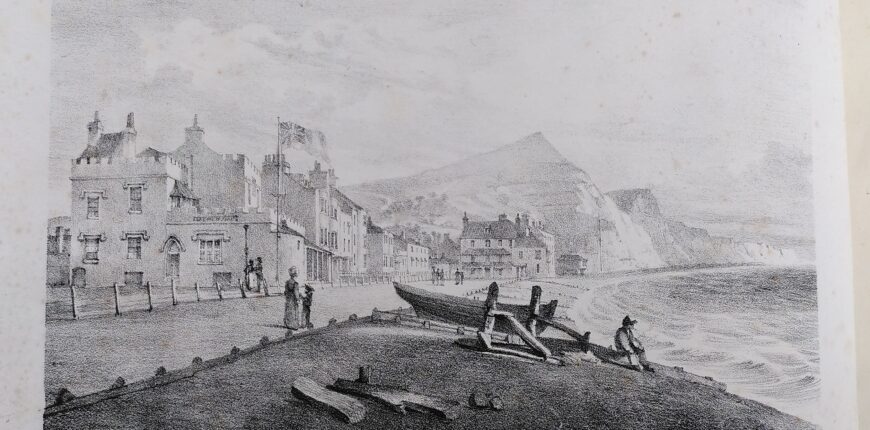
Forty-eight views of cottages and scenery at Sidmouth, Devon, drawn from nature and on stone (1826)
Born at Exeter in 1796, George Rowe showed artistic talent from an early age. While working as a drawing master at Hastings, he produced his first set of prints, Twenty-six Views of Picturesque Scenery of Hastings and its Vicinity (1823). Rowe published many more views of Sussex and Kent before returning to Exeter around 1826. Here, he worked as Drawing Master, while continuing to produce topographical prints of Exeter, Plymouth, and the local seaside towns. In his guide to Devon Topographical Prints, 1660-1870, J. V. Somers Cocks identifies Rowe, alongside William Spreat, as “the most important as well as the most prolific of the Devon artist-engravers or artist-lithographers” (6). He was one of the early producers of “tint” printing, a forerunner of chromo-lithography (Pycroft 126). Forty-eight views of cottages and scenery at Sidmouth (1826) was the first collection of prints Rowe produced after returning to Exeter. His Scenery in the north of Devon (c.1835) has also been identified as a star item in our Collections Review.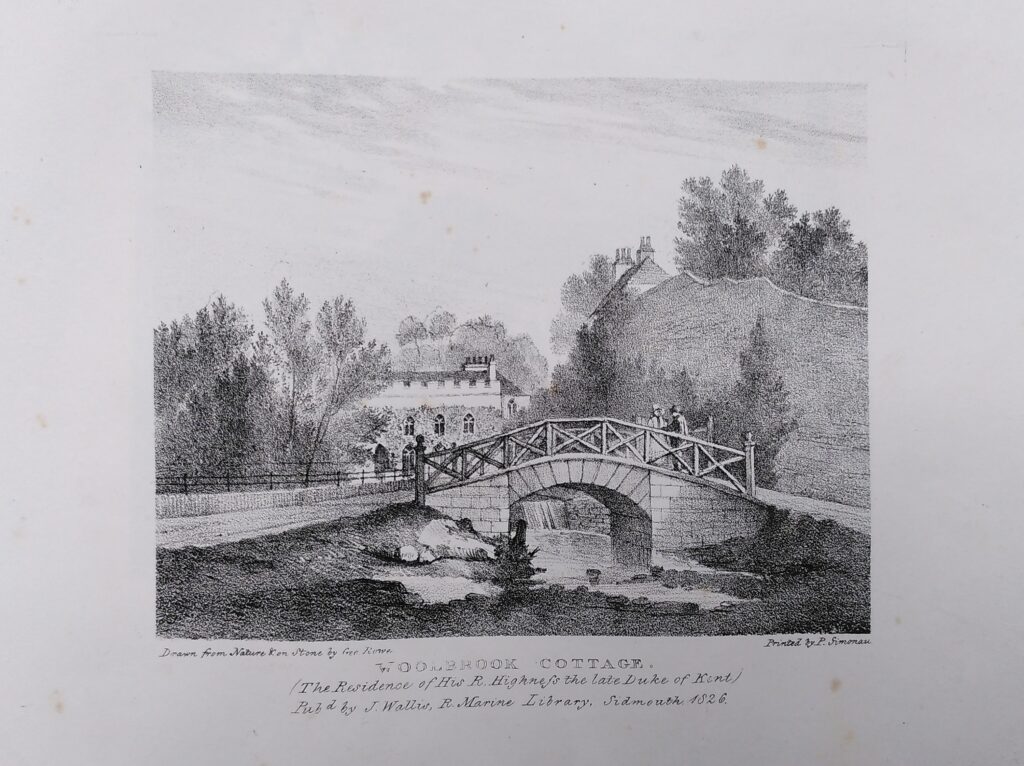 The Napoleonic Wars made travelling on the Continent difficult. In consequence, many English seaside towns experienced an economic boom in the early nineteenth century. Sidmouth, with its dramatic coastlines and picturesque views, was particularly popular. By the 1820s the town had blossomed into a fashionable watering place: the future Queen Victoria famously spent her first Christmas at Woolbrook Cottage, and other genteel and aristocratic visitors included Jane Austen, Elizabeth Barrett Browning, and the Grand Duchess Hélène of Russia.
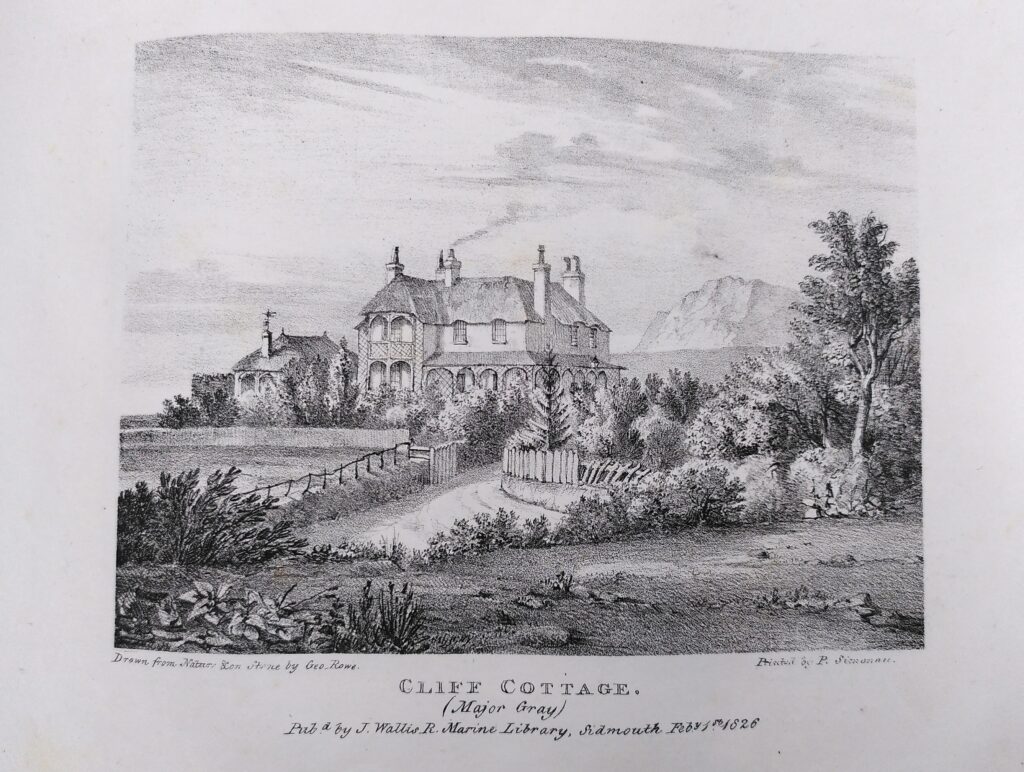
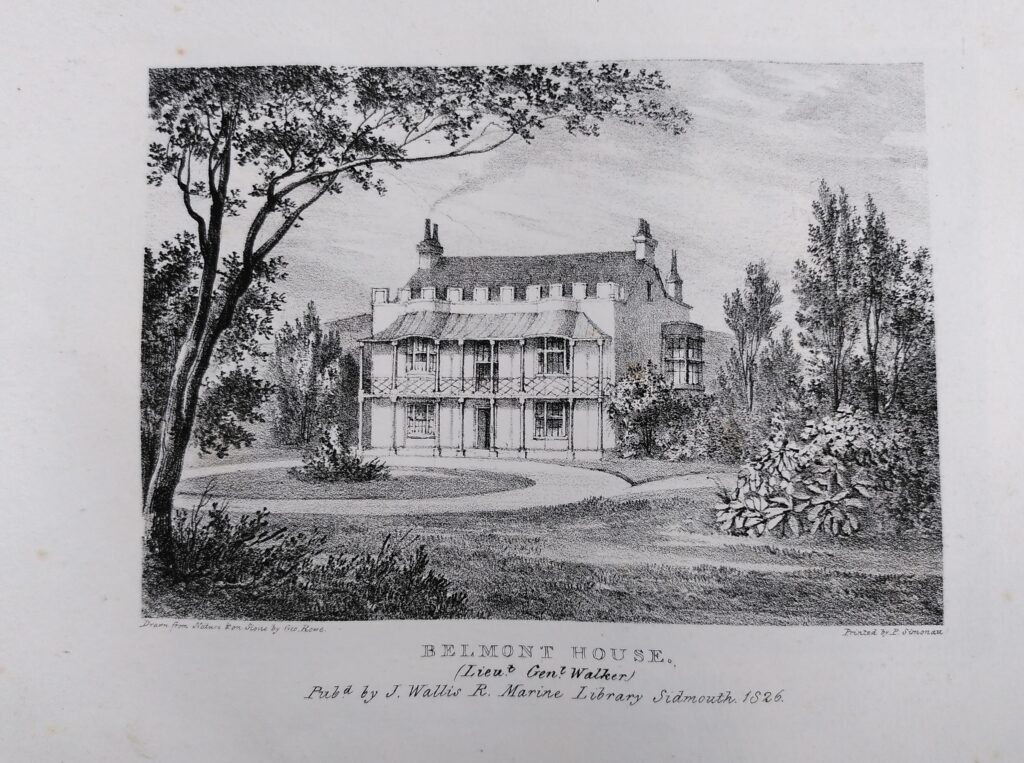
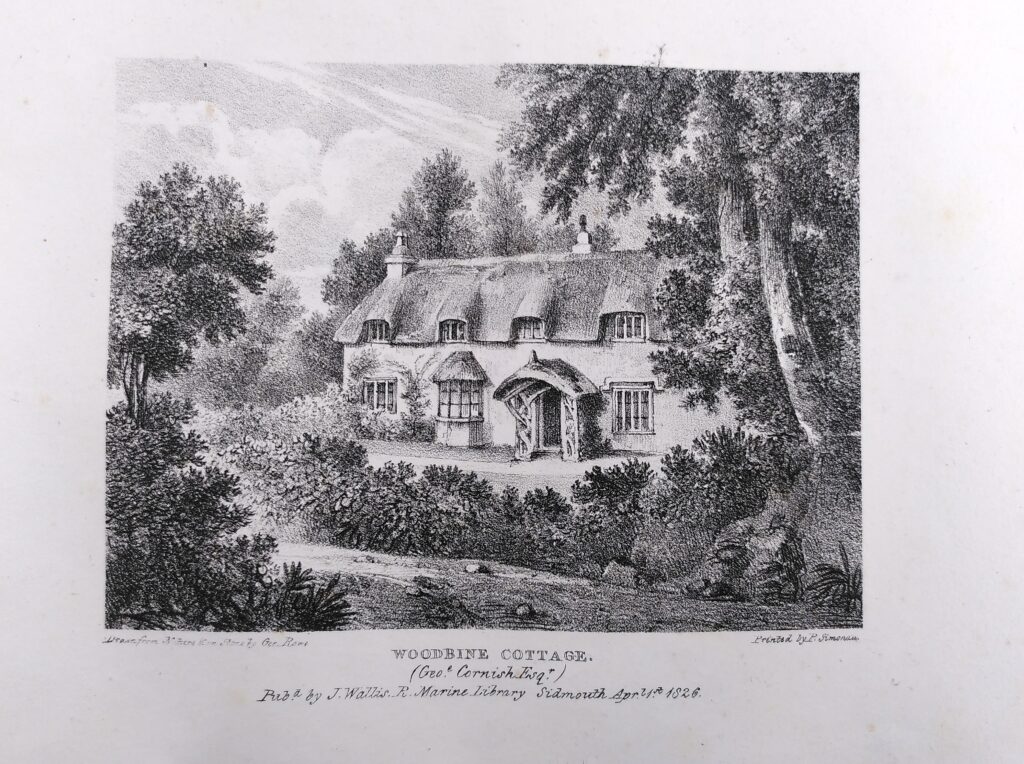
This new class of visitor required more refined lodgings, and flamboyant holiday homes sprang up around the town. Most were built in the style of the cottage orné, which aligned with popular Romantic ideals of rustic living. In Rowe’s prints, we can observe the key features of this style: asymmetrical layouts, thatched roofs, ornate timberwork, latticed windows, open verandahs and elaborate chimneys.
Jane Austen satirizes the fashion for cottages in Sense and Sensibility (1811), when the dandyish Robert Ferrars declares
“I am excessively fond of a cottage; there is always so much comfort, so much elegance about them. I advise everybody who is going to build, to build a cottage.” (248)
He is, of course, not thinking of the one-room dwelling of the rural labourer, but an aristocratic residence complete with drawing-room, library, saloon, and a dining parlour large enough to accommodate a dance of eighteen couples. Knowle Cottage, in Sidmouth, was one such house, boasting 40 rooms and 9 acres of gardens. By 1826, it belonged to Thomas Leversidge Fish, who opened it to the public as a show home. Fish’s ‘little paradise’, where exotic animals like parrots, kangaroos, and camels roamed the gardens, attracted thousands of visitors. Rowe includes two views of the house in his collection.
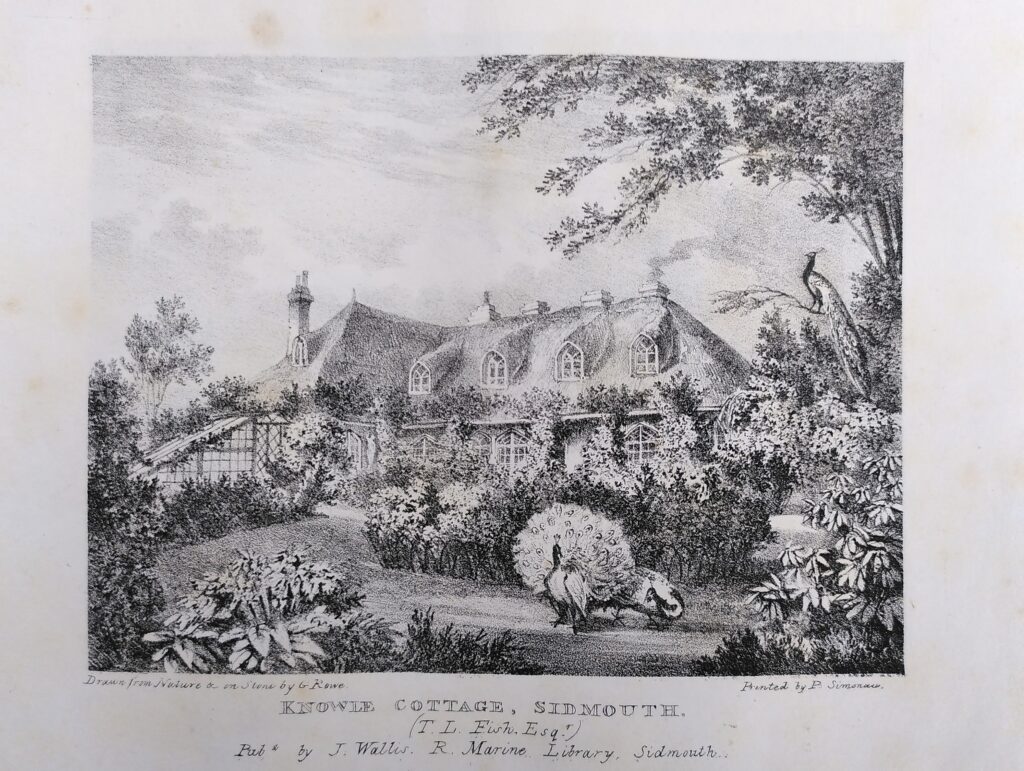
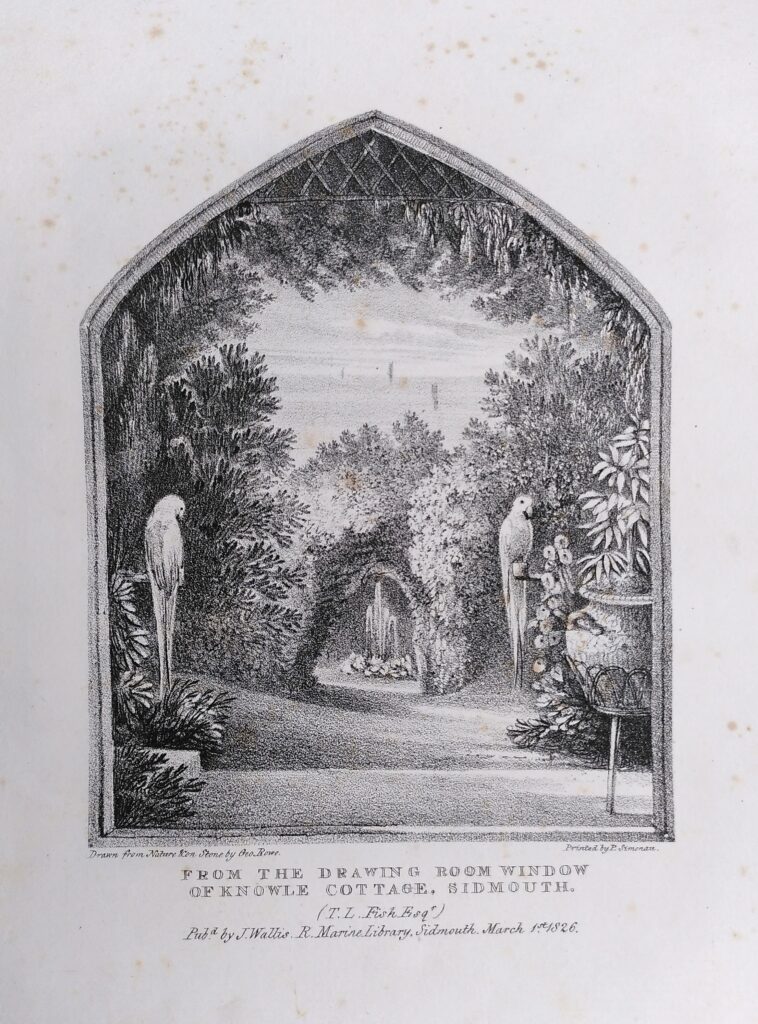 Forty-eight views of cottages capitalised on, and also fuelled, Sidmouth’s growing popularity as a seaside resort. Rowe’s prints capture the beautiful landscapes and fanciful architecture of the town, while the captions acknowledging the owners of particular cottages – the Duke of Kent, Major Gray, Lieutenant General Walker – affirm the exceptional calibre of its residents
. The collection was published by John Wallis, scion of a London publishing house, who had been sent to Sidmouth to capitalise upon the influx of wealthy visitors. As proprietor of the Royal Marine Library, he claimed the honourable title of “Bookseller to H. R. H. the Duchess of Kent”. It is likely that Wallis marketed Rowe’s collection to his patrons as a souvenir, and it was also sold in London, where it no doubt fuelled enthusiasm for the beauties of the Devonshire coast amongst the higher ranks of society.